The Indian markets exhibited a bullish sentiment on November 27, 2025, with major indices hitting record highs driven by growth optimism and easing valuations, though profit-taking led to a flat close. Key themes included positive IMF projections on GDP growth amid global tariff concerns, expectations of RBI monetary easing, and emphasis on structural reforms for sustainable development.
- Equity markets scale new peaks on strong economic forecasts.
- IMF projects 6.6% GDP growth despite US tariff impacts.
- RBI rate cut anticipation boosts investor confidence.
- Green steel financing highlights sustainable industrial shift.
- Labor reforms aim to enhance business ease and welfare.
Indian Equity Markets Scale Record Highs After 14 Months
India's Nifty 50 index hit a record high after 14 months, driven by growth optimism and easing valuations amid a stable macroeconomic environment. The Sensex climbed 110.87 points to close at 85,720.38, while the Nifty ended at 26,216 after touching an intra-day peak of 26,310.45. IT and private banking sectors led the gains, reflecting sustained domestic demand and policy momentum. Profit-taking in the latter session resulted in a flat close, but the rally marked a continuation from the previous day's significant jump. This performance underscores resilience in the face of global uncertainties, with indices surpassing previous records set in September 2024. The uptick is expected to bolster investor confidence and attract further foreign inflows into Indian equities.
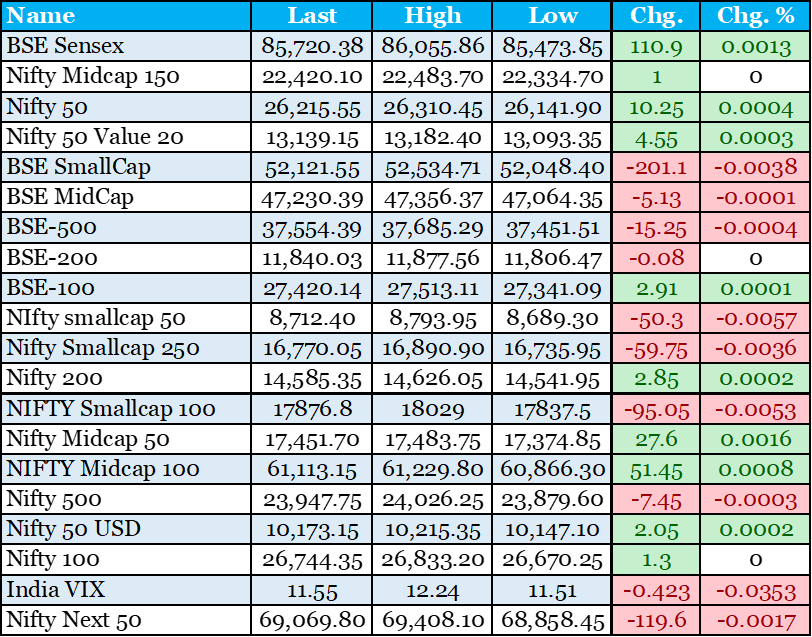
Reuters India - https://www.reuters.com/world/india/indias-nifty-50-hits-record-high-after-14-months-growth-optimism-easing-2025-11-27/
IMF Projects 6.6% GDP Growth for FY2025-26 Amid GST Reforms
The IMF forecasts India's GDP to expand by 6.6% in FY2025-26, supported by GST reforms that mitigate the adverse effects of potential US tariffs. Recent GST simplification, including rate reductions, is seen as a buffer against external shocks, promoting consumption and economic resilience. The projection accounts for a baseline scenario of prolonged 50% US tariffs, with growth moderating to 6.2% in FY2026-27. Strong domestic demand and fiscal consolidation contribute to this outlook, despite risks from geoeconomic fragmentation. The reforms are anticipated to offset tariff impacts, enhancing India's competitiveness in global trade. Overall, this positive assessment reinforces India's position as a fast-growing economy in a challenging global landscape. Financial Express - https://www.financialexpress.com/policy/economy-imf-projects-indias-gdp-to-grow-6-6-in-fy26-as-gst-reforms-cushion-impact-of-us-tariffs-4057687/
RBI Expected to Cut Rates to 5.25% in December Meeting
A Reuters poll indicates the Reserve Bank of India is likely to reduce its key repo rate by 25 basis points to 5.25% on December 5, responding to benign inflation trends. This would mark the first cut since February 2023, driven by low headline inflation and steady core inflation at 4.3%. Economists cite easing food prices and GST rationalization as factors enabling monetary easing without reigniting inflationary pressures. The move is expected to support economic growth amid global uncertainties, including potential US tariffs. Enhanced monetary transmission and exchange rate flexibility are recommended to absorb external shocks. This policy shift could boost market sentiment and stimulate borrowing in key sectors like manufacturing and infrastructure. Reuters India - https://www.reuters.com/world/india/indias-central-bank-expected-cut-rates-525-december-5-2025-11-27/
IMF Concludes 2025 Article IV Consultation with India
India's economy grew 6.5% in FY2024/25, with robust expansion of 7.8% in Q1 FY2025/26, supported by declining inflation and strong financial sectors. The IMF projects 6.6% growth in FY2025/26, urging continued fiscal consolidation and monitoring of GST impacts. Recommendations include targeted tariff relief, monetary easing if needed, and structural reforms to boost human capital and trade integration. Risks from geoeconomic fragmentation and weather shocks are highlighted, with emphasis on building resilience through innovation and green transitions. The consultation praises India's macroeconomic policies and calls for enhanced data quality and financial oversight. These measures aim to sustain high growth and achieve advanced economy status. IMF - https://www.imf.org/en/news/articles/2025/11/24/pr-25392-india-imf-executive-board-concludes-2025-article-iv-consultation
Top Performing Funds for You
Top Performing Equity Funds Top Performing Debt Funds Top Performing Hybrid FundsPublic Capital Key to Financing India's Green Steel Development
India's steel sector, emitting 12% of national greenhouse gases, faces high decarbonization costs, with green steel abatement ranging from US$110 to US$1,168 per tonne of CO2. Public financing is essential to overcome barriers like fossil fuel dependence and capacity expansion risks to 300 Mt by 2030. Recommendations include credit guarantees, contracts for difference, and project preparation facilities to mobilize private capital. Leapfrogging to hydrogen-based technologies can avoid carbon lock-in and secure price premiums of 20-30%. This transition promises job creation, reduced import costs, and global competitiveness in low-carbon materials. Strategic public investments will support sustainable growth and mitigate climate risks. IEEFA - https://ieefa.org/resources/critical-role-public-capital-financing-indias-green-steel-development
Labor Reforms Consolidate Laws to Boost Growth and Welfare
India's labor reforms merge 29 laws into four codes, enhancing ease of doing business and attracting investments toward a $10 trillion economy by 2047. Provisions extend social security to gig workers and equal benefits for fixed-term employees, potentially raising costs in e-commerce and manufacturing. State-level variations and trade union opposition pose implementation challenges, with demands for rollback. The changes aim to increase workforce flexibility and productivity, offsetting initial cost increases. These reforms are expected to catalyze industrialization and improve worker welfare. Overall, they represent a tricky balance between business interests and labor protections. CNBC - https://www.cnbc.com/2025/11/27/cnbc-inside-india-newsletter-labor-code-growth-worker-welfare.html
Top Performing Equity Fund Categories for You
Top Performing Large Cap Funds Top Performing Mid Cap Funds Top Performing Small Cap FundsIMF Reclassifies India's FX Regime to Crawl-Like Arrangement
The IMF has shifted India's foreign exchange classification from stabilised to crawl-like, reflecting gradual rupee adjustments against the US dollar. This change acknowledges RBI's data-dependent interventions to manage volatility amid external pressures. The reclassification aligns with India's resilient service exports and current account management. It supports recommendations for greater exchange rate flexibility to absorb shocks. Macro outlook includes 6.6% growth in FY2025-26, emphasising fiscal and monetary prudence. This adjustment may enhance transparency in currency management and investor perceptions. Reuters India - https://www.reuters.com/world/india/imf-reclassifies-indias-fx-management-regime-crawl-like-arrangement-stabilised-2025-11-26/
India Rejects IMF Assumptions on US Tariffs Impact
India disputes the IMF's baseline scenario of prolonged 50% US tariffs, claiming the growth impact is overstated due to alternative export markets. The government trimmed FY2024-25 GDP forecast to 6.6% and FY2026-27 by 20 basis points based on this. Officials argue for diversified trade strategies to mitigate risks. This response highlights confidence in domestic resilience and GST reforms. Potential effects on exports and FDI are downplayed, focusing on long-term growth paths. The stance aims to reassure markets amid global trade uncertainties. Business World - https://www.businessworld.in/article/india-rejects-imf-s-assumptions-on-us-tariffs-says-growth-impact-overstated-581461
India's Economic Outperformance in a Fragmented Global Economy
India achieved 7.8% growth in Q1 2025, outpacing major economies like the US and China, with IMF projecting 16% global growth contribution. Key drivers include robust domestic demand, infrastructure investments of ₹11 lakh crore, and PLI schemes boosting manufacturing exports. Services sector strength, digital infrastructure, and social programs enhance resilience amid global deceleration. Challenges like youth unemployment and regional imbalances require reforms in education and job creation. India positions as a supply chain alternative and digital governance model. This outperformance bolsters FDI and forex reserves, supporting long-term stability. Daily Excelsior - https://www.dailyexcelsior.com/indias-economic-outperformance-in-a-fragmented-global-economy/
Top Performing Debt Fund Categories for You
Top Performing Liquid Funds Top Performing Ultra Short Duration Funds Top Performing Corporate Bond FundsFinance Ministry Report Highlights High Growth and GST Benefits
India remains on a high growth path with a stable macro environment, eased inflation, and strong domestic demand. GST 2.0 rationalization boosts consumption, evidenced by 40.5% YoY auto sales growth in October. Inflation hit 0.25% low, with food prices declining sharply and agriculture showing strength. Corporate earnings rose 12.3%, financial markets stabilized, and service exports hit records. Risks include global trade uncertainty and supply disruptions. The report underscores resilience through policy measures and festive demand. Zee Business - https://www.zeebiz.com/economy-infra/news-india-still-on-high-growth-path-gst-20-impact-favourable-10-takeaways-from-finance-ministry-report-384189