The Indian markets exhibited a bearish sentiment on November 21, closing lower amid profit-taking and global sell-off pressures from inconclusive U.S. jobs data. The rupee's record low against the USD added to the volatility, while regulatory changes and corporate announcements provided mixed cues. Key themes included currency depreciation, policy reforms in capital markets, and sector-specific corporate developments driven by fundraising and expansions.
- Markets snap two-day gain as Sensex falls 401 points amid global cues.
- Rupee hits record low, impacting import costs and investor confidence.
- SEBI bans mutual funds from pre-IPO placements to enhance transparency.
- Infosys announces Rs 18,000 crore buyback, boosting IT sector sentiment.
- Groww reports 12% profit jump despite revenue dip in Q2.
Sensex Settles 401 Points Lower Amid Profit-Taking
Indian benchmark indices closed lower due to widespread selling across sectors, with the Sensex dropping 400.76 points to 85,231.92 and Nifty declining 124 points to 26,068.15. The downturn snapped a two-day gaining streak, influenced by a global sell-off triggered by mixed U.S. jobs data that clouded interest rate outlooks. Metal and realty sectors led the losses, falling over 2%, while broader markets underperformed with midcap and smallcap indices down 1% each. Despite the daily decline, weekly gains remained positive at 0.8% for Sensex and 0.6% for Nifty. Market breadth favored bears, with advance-decline ratio at 1:2, signaling limited participation in recent rallies. Volatility rose 13% as India VIX hit 13.68, reflecting heightened uncertainty.
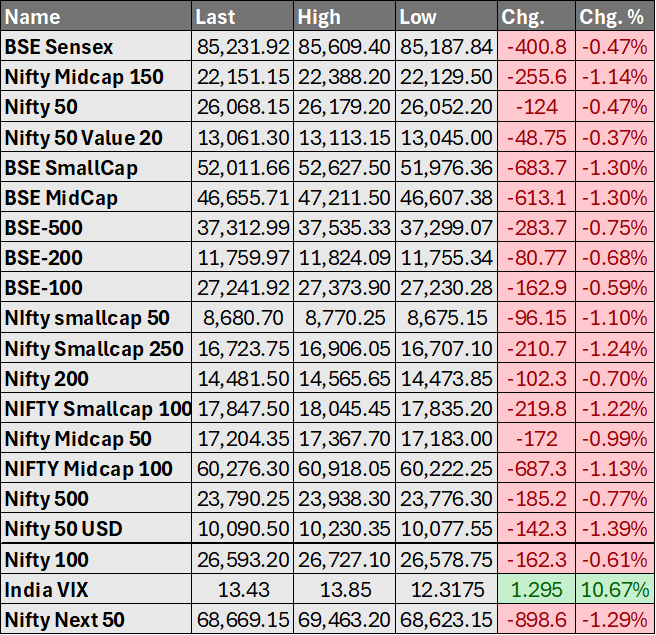
Economic Times - https://economictimes.indiatimes.com/markets/stocks/live-blog/bse-sensex-today-live-nifty-stock-market-updates-21-november-2025/liveblog/125475179.cms
Rupee Closes at Record Low of 89.48 Against USD
The Indian rupee depreciated sharply to a record closing low of 89.48 per U.S. dollar, down 0.87% in a single session. This marked the biggest daily fall since May, driven by subdued risk appetite and fading expectations of a Federal Reserve rate cut. Uncertainty over U.S.-India trade negotiations further pressured the currency, with no visible RBI intervention. The rupee's weakness raised concerns over higher import costs, particularly for oil and electronics, potentially fueling inflation. It emerged as the worst performer among Asian currencies that day. This forex movement contributed to cautious equity trading and could impact corporate earnings reliant on imports.
SEBI Prohibits Mutual Funds from Pre-IPO Placements
Markets regulator SEBI barred mutual funds from participating in pre-IPO share placements to improve liquidity and valuation transparency in initial public offerings. Funds remain allowed to invest in anchor rounds, which are seen as more regulated. The move aims to mitigate potential conflicts of interest and ensure fairer pricing for retail investors. This regulatory shift could alter fundraising strategies for companies planning IPOs, pushing more reliance on anchor allocations. It reflects SEBI's focus on protecting investors amid a surge in primary market activity. The policy may reduce mutual fund exposure to high-risk pre-listing deals.
Infosys Announces Rs 18,000 Crore Share Buyback
IT major Infosys launched a Rs 18,000 crore share buyback program, offering potential short-term gains to shareholders amid weak demand in the sector. The initiative provides a price floor and enhances returns through capital redistribution. Analysts expect limited operational changes but improved investor sentiment and valuations. Backed by strong cash flows, the buyback leverages long-term tech spending trends. It could stabilize Infosys stock during market volatility. This move highlights confidence in fundamentals despite global headwinds.
Groww Q2 Profit Rises 12% YoY to Rs 471 Crore
Online brokerage Groww reported a 12% year-on-year profit increase to Rs 471 crore for Q2, despite a 9.5% revenue drop to Rs 1,018.7 crore. The results reflect challenges in the fintech space amid market fluctuations. Shares rallied 7% pre-earnings, recovering from recent declines. This performance underscores resilience in digital broking. It may influence investor views on fintech valuations. The earnings highlight sector trends toward profitability over growth.
Meesho Targets $6 Billion Valuation in December IPO
E-commerce firm Meesho plans a December IPO at a $6 billion valuation, with an issue size of about Rs 60 billion. Discussions for a pre-IPO placement with SBI Funds could adjust the offering. This marks a key listing in the digital retail space. It capitalizes on India's e-commerce boom. The move may attract foreign investments. Success could spur more tech IPOs.
Economic Times - https://economictimes.indiatimes.com/markets/ipos/fpos/meesho-eyes-6-billion-valuation-with-december-ipo/articleshow/125486891.cms
Kotak Mahindra Bank Approves Stock Split
Kotak Mahindra Bank approved subdividing shares from Rs 5 to Re 1 face value, its first split in 15 years. The action aims to boost affordability and retail participation. It coincides with the bank's 40th anniversary. This could enhance liquidity in banking stocks. It reflects sector optimism. The split may draw more individual investors.
Top Performing Funds for You
Top Performing Equity Funds Top Performing Debt Funds Top Performing Hybrid FundsAxis Bank to Raise Rs 5,000 Crore via NCDs
Axis Bank announced plans to issue Rs 5,000 crore in non-convertible debentures, with a base of Rs 2,000 crore and greenshoe option. The private placement strengthens capital for lending. It occurs amid banking sector fundraising. This could support credit growth. It impacts fixed-income markets. Investors may see stable yield opportunities.
Economic Times - https://economictimes.indiatimes.com/markets/banking/axis-bank-to-raise-rs-5000-cr-via-ncds-on-private-placement-basis/articleshow/125475179.cms
Tata Power Signs Deal for Bhutan Hydropower Project
Tata Power and Druk Green agreed to develop a 1,125 MW hydropower project in Bhutan, with Rs 15.72 billion equity from Coal India. This advances renewable energy ties. It boosts cross-border infrastructure. The project enhances regional power supply. It aligns with green transition goals. Sector shifts toward sustainable energy are evident.
JSW Energy Wins Approval for Raigarh Rail Insolvency Plan
JSW Energy's resolution plan for Raigarh Champa Rail Infrastructure was approved under insolvency proceedings. The asset supports coal transport for power plants. This acquisition expands JSW's energy infrastructure. It follows prior KSK Mahanadi buy. NCLT approval is pending. The deal strengthens operational synergies in power sector.