Indian markets closed sharply lower on January 9, reflecting a bearish sentiment driven by global trade uncertainties, Trump tariff threats, and heavy foreign outflows, though long-term growth projections remain optimistic. Volatility dominated, with major indices extending losses amid geopolitical risks, but resilient consumption and public investment buoyed economic forecasts.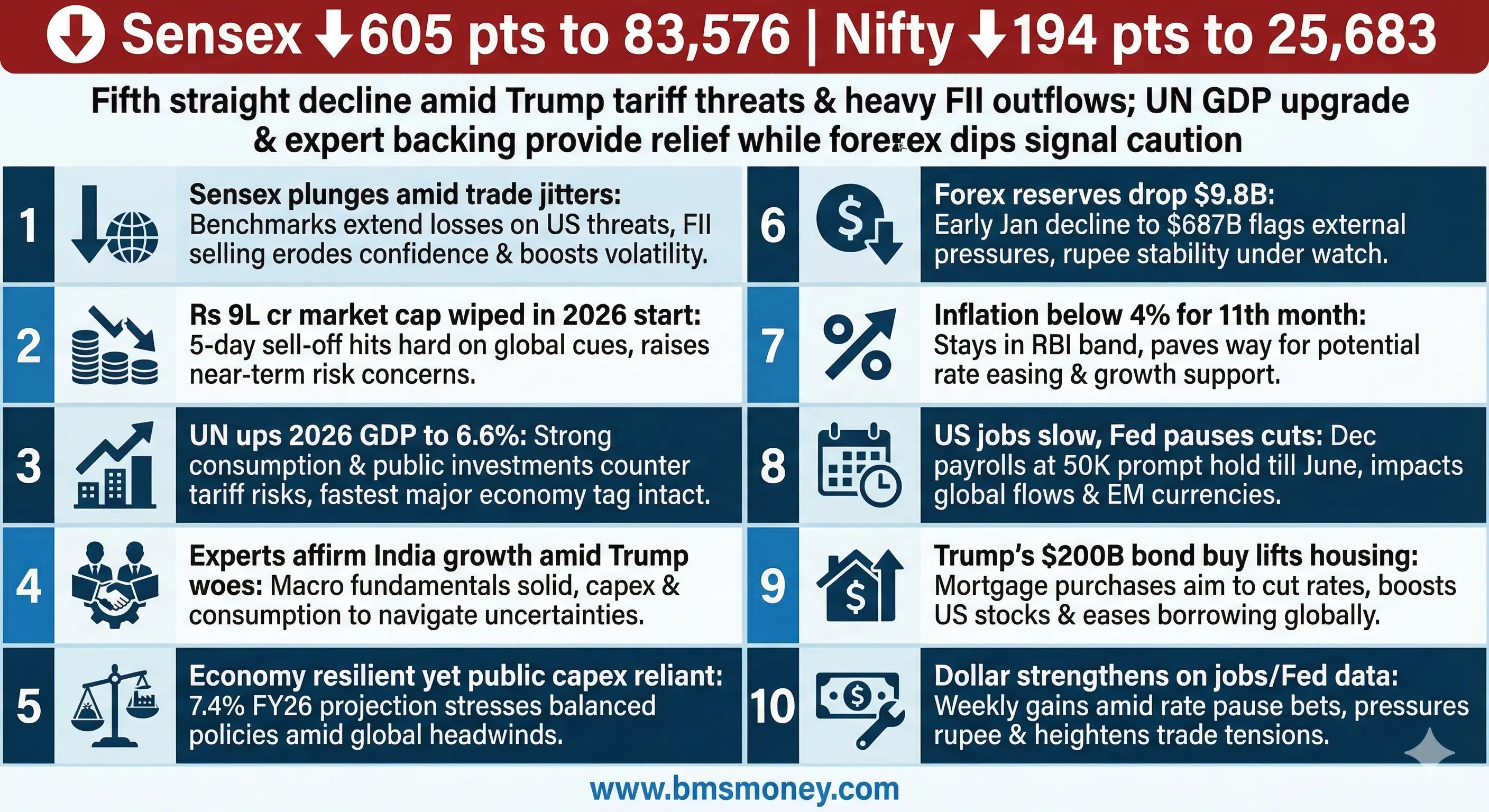
Sensex Plunges 604 Points Amid Global Trade Jitters
The Indian stock market experienced a significant downturn on January 9, 2026. The Sensex index closed down by 604.72 points at 83,576.24. Similarly, the Nifty fell by 193.55 points to settle at 25,683.30. This marked the fifth consecutive session of losses for the major indices. The decline was primarily driven by persistent foreign institutional investor selling. Global trade tensions, particularly threats of tariffs from the US under President Trump, added to the pressure. Political uncertainty emanating from Washington further eroded investor confidence. Market volatility reached heightened levels as a result. Sectors like IT and banking were among the hardest hit. Auto and consumer goods stocks also saw notable declines. Analysts attribute part of the sell-off to profit booking after recent highs. FII outflows amounted to substantial figures in the session. Domestic institutional investors provided some support but could not stem the tide. The rupee weakened slightly against the dollar amid these developments. Broader market indices like the midcap and smallcap also ended in the red. Trading volumes remained high, indicating active participation despite the bearish tone. Experts warn of continued short-term volatility. Long-term investors are advised to focus on fundamentals. The day's events underscore the interconnectedness of global markets. Overall, the sentiment shifted towards caution for the immediate future.
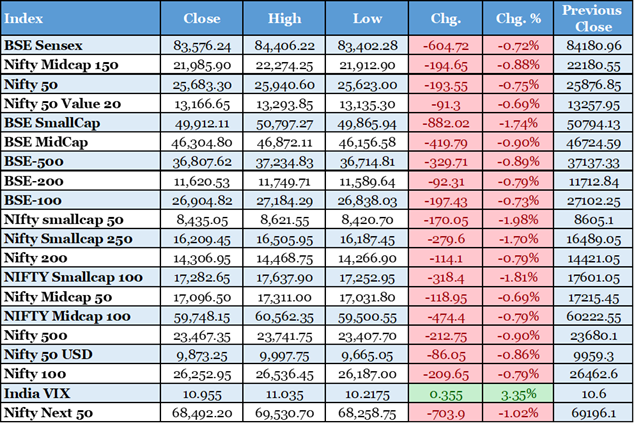
The Economic Times, https://economictimes.indiatimes.com/markets/stocks/live-blog/bse-sensex-today-live-nifty-stock-market-updates-09-january-2026/liveblog/126425458.cms
Rs 9 Lakh Crore Market Cap Lost in Brutal Start to 2026
The Indian equity markets suffered a massive erosion in value over the first five trading days of 2026. Approximately Rs 9 lakh crore was wiped out from the total market capitalization. This brutal start was fueled by escalating global trade fears. Heavy outflows from foreign institutional investors exacerbated the situation. The indices entered a clear risk-off phase as a result. Concerns over sustained market volatility have risen sharply. Investors are reevaluating their portfolios in light of these developments. Sectoral indices showed widespread weakness across the board. Banking stocks led the declines due to interest rate sensitivities. Technology firms faced pressure from potential US policy shifts. Commodity-linked sectors were hit by fluctuating global prices. The sell-off reflects broader emerging market trends. Domestic economic indicators remain mixed in this context. Government bonds saw some safe-haven buying. Gold prices edged higher as an alternative asset. Analysts predict a possible rebound if global cues improve. However, near-term downside risks persist. Retail investor participation has slowed amid the turmoil. Mutual funds are advising caution to their clients. The event highlights the vulnerability to external shocks. The Economic Times, https://economictimes.indiatimes.com/markets/stocks/news/bad-start-to-2026-as-rs-9-lakh-crore-lost-in-5-days-what-should-stock-market-investors-do/articleshow/126434430.cms
UN Projects 6.6% Growth for India in 2026 on Strong Consumption
The United Nations has upgraded its growth forecast for India in 2026. The new projection stands at 6.6 percent GDP growth. This optimism is based on resilient private consumption patterns. Public investment is also cited as a key offsetting factor. Potential impacts from US tariffs are expected to be mitigated. India is positioned as one of the fastest-growing major economies. Global headwinds are acknowledged but not seen as derailing progress. Domestic demand drivers remain robust according to the report. Infrastructure spending continues to support expansion. Agricultural output is projected to contribute positively. Manufacturing sectors show signs of recovery. Services industry leads with strong performance. Fiscal policies are aligned with growth objectives. Monetary conditions are supportive of investment. Labor market improvements aid consumption. Export sectors may face challenges from trade barriers. Import dependencies are being managed effectively. Innovation and technology adoption boost productivity. Demographic advantages provide long-term tailwinds. The forecast reinforces confidence in India's economic trajectory. The Economic Times, https://economictimes.indiatimes.com/news/economy/indicators/india-to-grow-6-6-in-2026-on-strong-consumption-public-investment-un/articleshow/126420435.cms
Market Experts Back India's Growth Story Amid Trump Uncertainties
Despite geopolitical risks from US policies, experts remain positive on India. Rising uncertainties under Trump are noted as short-term hurdles. India's macro fundamentals are described as strong and intact. Key growth drivers include capital expenditure cycles. Private consumption is expected to remain a pillar of strength. Structural reforms continue to yield benefits. Fiscal discipline is maintained at healthy levels. Monetary policy framework supports stability. Inflation management has been effective recently. External sector balances are monitored closely. Investment in infrastructure propels economic activity. Digital economy expansion adds to growth momentum. Renewable energy initiatives create new opportunities. Healthcare and education sectors see increased focus. Global supply chain shifts favor India. Trade diversification strategies are in place. Domestic market size provides a buffer. Innovation ecosystems are thriving nationwide. Talent pool remains a competitive advantage. Overall, the growth narrative holds firm. Moneycontrol, https://www.moneycontrol.com/news/business/markets/market-experts-back-india-growth-story-amid-growing-trump-driven-global-uncertainty-13766168.html
India's Economy Resilient but Reliant on Public Investment
India's economy demonstrates notable resilience in current projections. Growth for FY26 is estimated at 7.4 percent. However, heavy reliance on public capital expenditure is highlighted. This dependence underscores the need for balanced policies. Fiscal strategies must complement monetary actions. Global complexities add layers of challenge. Private sector investment needs encouragement. Regulatory environments are evolving to support business. Tax reforms aim to broaden the base. Subsidy rationalization frees up resources. Debt management remains prudent. Revenue mobilization efforts are intensified. Expenditure quality is under scrutiny. Economic diversification reduces vulnerabilities. Regional development initiatives promote inclusivity. Skill development programs enhance employability. Sustainability goals integrate into planning. International partnerships strengthen trade ties. Risk mitigation frameworks are strengthened. The outlook emphasizes sustainable and inclusive growth. Moneycontrol, https://www.moneycontrol.com/news/opinion/india-s-economy-is-resilient-but-highly-dependent-on-public-investment-13764903.html
Forex Reserves Drop by $9.8 Billion in Early January
India's foreign exchange reserves experienced a sharp decline recently. The drop amounted to USD 9.809 billion in the week ending January 2. Reserves now stand at USD 686.801 billion. This reflects ongoing external economic pressures. Currency stability could be impacted as a result. Import cover metrics are being reassessed. The rupee's value is under watch by markets. Central bank interventions may increase. Global capital flows influence reserve levels. Trade balance dynamics play a role. Remittances provide some support. FDI inflows are monitored for trends. Portfolio investments show volatility. Gold reserves component remains stable. Foreign currency assets form the bulk. Valuation changes contribute to fluctuations. Policy responses aim to build buffers. Economic diplomacy seeks to attract funds. Diversification of reserves is considered. The situation calls for vigilant management. The Economic Times, https://economictimes.indiatimes.com/markets/stocks/live-blog/bse-sensex-today-live-nifty-stock-market-updates-09-january-2026/liveblog/126425458.cms
Inflation Below RBI's 4% Target for 11th Straight Month
Consumer price inflation in India stayed subdued. It remained below the RBI's 4 percent medium-term target. This marks the 11th consecutive month of such performance. The rate is within the 2-6 percent tolerance band. This trend supports potential for monetary easing. Interest rate decisions could be influenced positively. Economic growth may benefit from lower rates. Borrowing costs for businesses could decrease. Household savings behaviors might shift. Food inflation components are stable. Fuel prices contribute to moderation. Core inflation shows controlled levels. Supply chain efficiencies aid price stability. Weather patterns impact agricultural prices. Global commodity trends are factored in. Policy tools are deployed effectively. Surveillance mechanisms are in place. Future projections indicate continued moderation. Stakeholder consultations inform decisions. The achievement bolsters economic confidence. Financial Express, https://epaper.financialexpress.com/r/4103689
US Jobs Growth Slows, Prompting Fed Rate Cut Pause
US nonfarm payrolls added only 50,000 jobs in December. This figure fell below market expectations significantly. Unemployment rate dipped to 4.4 percent nonetheless. Markets now anticipate the Fed holding rates steady. A pause until at least June is widely expected. This impacts global financial sentiment broadly. Indian markets feel the ripple effects through capital flows. Emerging economies monitor US policy closely. Dollar strength could pressure local currencies. Trade relations are under scrutiny. Investment strategies are adjusted accordingly. Economic data releases drive volatility. Analyst forecasts are revised frequently. Policy communications from the Fed are key. Labor market tightness persists in sectors. Wage growth trends are observed. Productivity metrics influence outlooks. Inflation targets guide decisions. International spillovers are acknowledged. The scenario shapes global recovery paths. Reuters, https://www.reuters.com/business/finance/fed-seen-longer-rate-cut-pause-after-jobs-data-2026-01-09/
Trump's $200 Billion Mortgage Bond Buy Boosts Housing Stocks
President Trump ordered purchases of $200 billion in mortgage bonds. This move aims to lower housing costs in the US. Housing-related stocks surged in response. The initiative targets reduced mortgage spreads. Global real estate sectors may see indirect influences. Financial markets react to such policy actions. Bond yields could be affected domestically. Credit availability improves for homebuyers. Economic stimulus is embedded in the plan. Sector confidence receives a boost. Investor appetite for related assets increases. Regulatory frameworks support implementation. Market liquidity is enhanced. Risk premiums adjust accordingly. Long-term housing affordability is addressed. Construction activity may rise. Employment in realty sectors benefits. Policy evaluations are ongoing. International benchmarks are considered. The program underscores housing priority. Reuters, https://www.reuters.com/business/finance/us-mortgage-lenders-rally-trump-administrations-plan-buy-200-billion-bonds-2026-01-09/
Dollar Strengthens on US Jobs Data and Fed Outlook
The US dollar advanced following mixed jobs data. It extended its weekly gains notably. Traders bet on a Fed pause in rate cuts. This affects emerging market currencies adversely. The Indian rupee faces heightened trade tensions. Exchange rate volatility increases globally. Capital flow directions shift. Hedging strategies are employed by corporates. Central banks monitor developments closely. Economic linkages amplify impacts. Policy divergences between nations widen. Inflation differentials play a role. Trade balances are influenced. Investment portfolios are rebalanced. Risk sentiments drive movements. Analytical models predict trends. Historical patterns provide insights. Geopolitical factors add complexity. Market participants remain vigilant. The outlook suggests continued strength. Reuters, https://www.reuters.com/world/asia-pacific/dollar-advances-with-us-jobs-data-supreme-court-ruling-view-2026-01-09/