Indian markets closed sharply lower on February 24, 2026, as a steep IT sector sell-off triggered by AI disruption fears and renewed US tariff uncertainties erased recent gains. Broad-based selling across autos and technology, coupled with cautious central bank signals, pushed benchmarks into bearish territory amid heightened volatility.
Indian Benchmarks Tumble Over 1% as IT Sell-Off and Tariff Fears Dominate
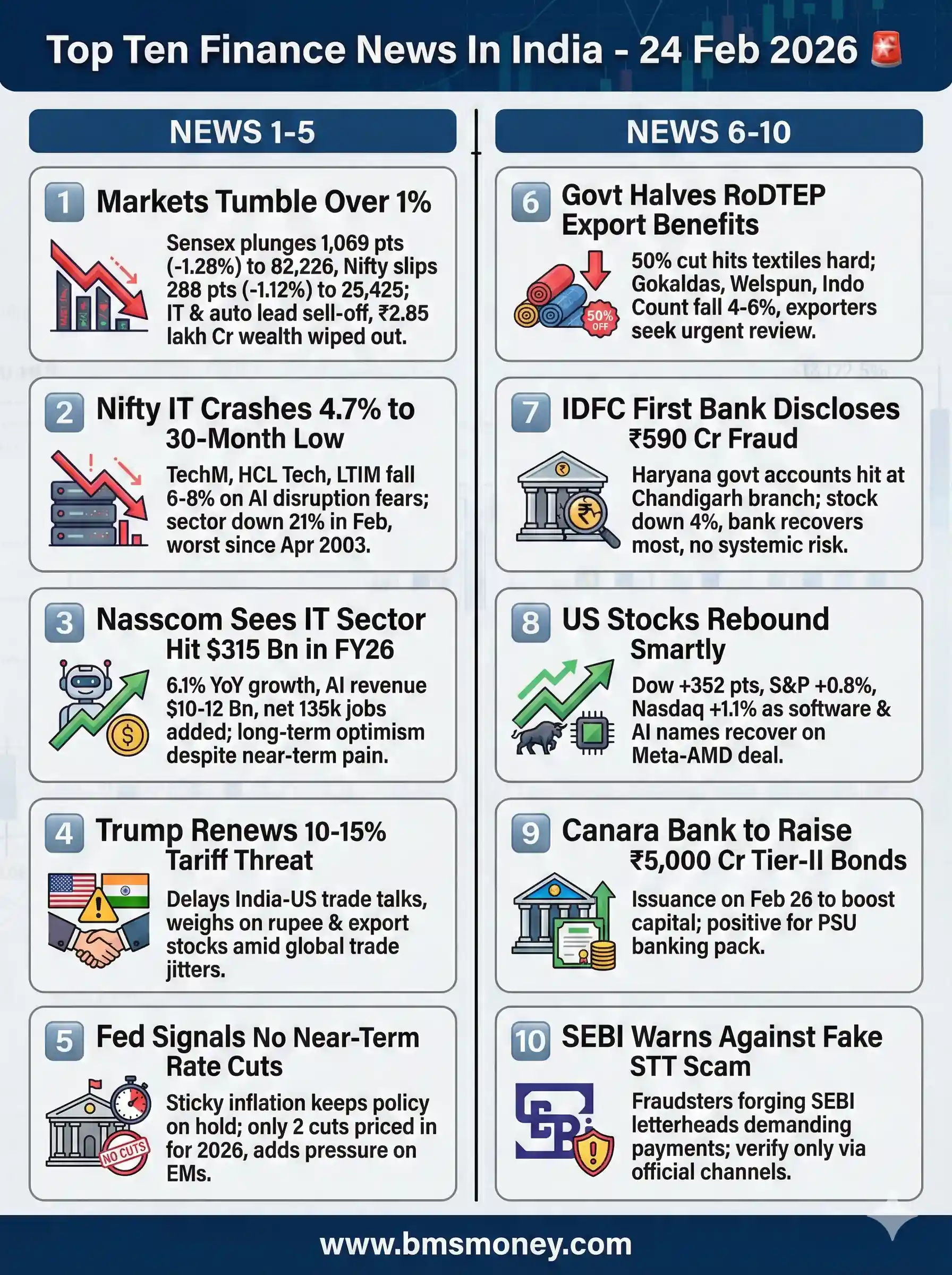
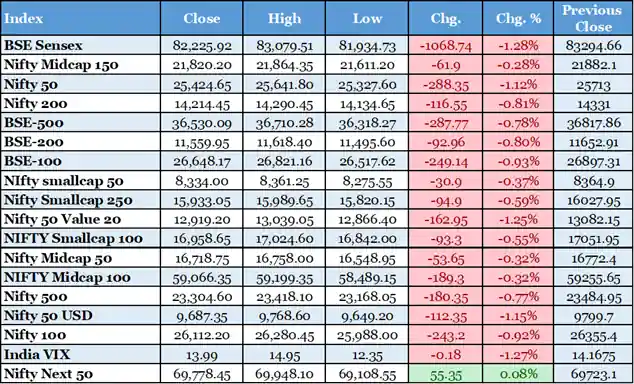
Indian equity markets witnessed a sharp decline on February 24, 2026, with the BSE Sensex dropping 1,068.74 points or 1.28% to settle at 82,225.92, while the Nifty 50 lost 288.35 points or 1.12% to close at 25,424.65. The sell-off was broad-based but led by heavy unwinding in IT, auto, and select banking stocks, coinciding with the weekly F&O expiry that amplified volatility. Market participants erased nearly ₹2.85 lakh crore in investor wealth in a single session, marking the steepest fall in four trading days.
Mid-cap and small-cap indices also corrected by 0.8-1.2%, reflecting risk aversion across the board. Foreign institutional investors turned net sellers to the tune of ₹1,450 crore, while domestic institutions provided some support with marginal buying. The downturn was triggered by a combination of global headwinds, including escalating US tariff rhetoric and persistent concerns over AI’s potential to disrupt traditional outsourcing models. On the domestic front, cautious commentary from global brokerage houses on India’s valuation premium added to the negative sentiment. Sectorally, IT lost over 4%, metals and pharma offered minor resilience, while auto and consumer durables remained under pressure. Analysts noted that the market is now pricing in delayed rate cuts globally and slower export momentum, with immediate focus shifting to the upcoming RBI policy review and Q4 corporate earnings season.
Economic Times
Nifty IT Index Slumps 4.7% to 30-Month Low on AI Disruption Fears
The Nifty IT index suffered its sharpest single-day fall in over two years, plunging 4.7% to close at a 30-month low of 38,245. Heavyweight stocks bore the brunt: Tech Mahindra crashed 7.8%, HCL Technologies tumbled 6.9%, LTIMindtree declined 6.4%, and Persistent Systems shed 5.9%. Even the bellwethers were not spared, with TCS down 3.1%, Infosys losing 2.7%, and Wipro sliding 4.2%. The sector is now down 21% for the month of February, its worst monthly performance since April 2003.
Market analysts attributed the rout to growing investor nervousness that rapid advancements in generative AI could significantly reduce demand for traditional IT services and business process outsourcing over the next 12-24 months. Brokerage notes from Morgan Stanley and Goldman Sachs highlighted potential margin compression and slower deal wins in the near term. Volume in IT stocks surged 40% above the 30-day average, indicating aggressive position cutting by both domestic and foreign investors. While long-term AI adoption is viewed positively by Nasscom, the near-term uncertainty has clearly dominated sentiment. Technical analysts warn that the index has broken key support at 39,500 and could test 36,800 in the coming sessions if global risk appetite does not improve.
Reuters
Nasscom Forecasts Indian IT Sector to Surpass $300 Billion in FY26
Nasscom, the apex industry body for Indian technology companies, released its annual strategic review projecting the domestic IT-BPM industry to grow 6.1% year-on-year and cross the $300 billion milestone for the first time, reaching $315 billion in FY26. The forecast assumes a gradual recovery in global spending, particularly in North America and Europe, coupled with accelerated AI and cloud adoption. The report estimates AI-related revenue from Indian services firms alone to touch $10-12 billion in the coming fiscal.
Employment outlook remains positive with a net addition of 135,000 professionals, taking the total workforce to 5.95 million. Nasscom Chairman highlighted that while traditional outsourcing faces headwinds, the shift towards AI-first solutions, digital engineering, and cybersecurity will drive the next leg of growth. The body also urged the government to accelerate data protection framework implementation and skill development programmes to maintain India’s competitive edge. Market reaction was muted as the positive long-term narrative was overshadowed by immediate stock weakness. Brokerages maintained “neutral to positive” stance on the sector with the caveat that valuation multiples need to compress further before fresh buying emerges.
Reuters
Trump’s Renewed Tariff Threats Weigh on Indian Market Sentiment
US President Donald Trump reiterated his aggressive trade stance on February 23, warning of temporary global tariffs up to 15% on imports from countries that do not conclude bilateral deals on US terms. The comments specifically mentioned delays in negotiations with India, citing persistent trade imbalances in pharmaceuticals, IT services, and automobiles. Indian officials confirmed that the next round of talks scheduled for early March has been postponed indefinitely, adding to uncertainty for export-oriented sectors that contribute nearly 20% of India’s GDP.
The rupee weakened 0.4% to 84.12 against the dollar, while Asian markets including Japan’s Nikkei and South Korea’s Kospi also closed in the red. Indian exporters, particularly in gems & jewellery, textiles, and engineering goods, expressed deep concern over potential margin erosion. Market strategists at Kotak Institutional Equities revised their FY26 Sensex target downward by 4% citing prolonged trade friction. The development also raised fears of retaliatory measures and supply-chain disruptions, prompting defensive positioning in domestic consumption and infrastructure plays.
Business Standard
Fed Officials Signal No Near-Term Rate Cuts Amid Sticky Inflation
In separate speeches on February 24, Boston Fed President Susan Collins and Richmond Fed President Thomas Barkin emphasised that US monetary policy remains “well positioned” and that interest rates are likely to stay unchanged for the foreseeable future. Both officials noted that core PCE inflation is still hovering around 2.6-2.8%, well above the 2% target, and that greater confidence in sustained disinflation is required before any policy easing. Collins particularly highlighted resilient consumer spending and tight labour market conditions as factors supporting the hold stance.
Bond markets reacted immediately, with 10-year Treasury yields rising 7 basis points to 4.38%. Fed funds futures now price in only two rate cuts for the remainder of 2026, down from three previously expected. The hawkish tone further pressured global risk assets, including Indian ADRs that trade in the US. Indian bond yields also edged higher by 3-4 basis points in sympathy. Economists at Nomura and HSBC noted that delayed US rate cuts could keep the Indian rupee under pressure and delay domestic monetary easing by the RBI, thereby capping upside for rate-sensitive sectors such as real estate and automobiles.
Reuters
Government Halves RoDTEP Export Benefits, Impacting Textile and Export Stocks
The Directorate General of Foreign Trade issued a notification slashing RoDTEP rates by 50% across all HS lines with immediate effect, citing the need to align with the reduced budgetary allocation for FY27. The move is expected to reduce the overall outgo by approximately ₹4,500 crore annually. Textile and apparel stocks reacted sharply: Gokaldas Exports fell 5.6%, Welspun Living declined 4.8%, and Indo Count Industries dropped 3.9%. Exporters across segments warned that the reduction, coming at a time of intense competition from Bangladesh and Vietnam, could render many shipments unviable.
The government later clarified that benefits for agri, food, and certain pharma products remain untouched. Industry associations have petitioned the Commerce Ministry for a phased implementation and review of the rates. Analysts at ICRA estimate that the textile sector’s EBITDA margins could compress by 80-120 basis points, potentially slowing export growth from the current 8-10% trajectory. The development adds to existing challenges from global demand slowdown and elevated freight costs, prompting investors to reassess exposure to export-heavy mid-cap names.
Times of India
IDFC First Bank Discloses ₹590 Crore Fraud in Haryana Government Accounts
IDFC First Bank disclosed that unauthorised transactions amounting to nearly ₹590 crore were detected at its Chandigarh branch involving accounts linked to Haryana government departments. The fraud allegedly involved internal staff collusion and was executed over several weeks in late 2025. The bank promptly filed an FIR with Chandigarh Police, informed the RBI, and has already reconciled or recovered the majority of the amount. The RBI stated that the incident poses no systemic risk to the banking sector.
Haryana government immediately de-empanelled the lender for all future government business. The stock, which had fallen nearly 9% intraday on the disclosure, recovered some ground to close 4.2% lower as investors took comfort from the bank’s swift response and strong capital position (CET-1 ratio at 15.8%). Brokerages maintained “buy” ratings citing robust underlying business momentum and limited long-term impact. The episode has, however, renewed focus on internal controls and governance standards across private sector banks handling public funds.
Times of India
US Stocks Rebound as Software and AI-Related Names Recover
US equity markets staged a smart recovery on February 24, with the Dow Jones Industrial Average rising 352 points or 0.85%, the S&P 500 gaining 0.82%, and the Nasdaq Composite advancing 1.12%. The rebound was led by software and semiconductor stocks that had been battered the previous session. AMD surged 6.4% after Meta announced a multi-billion-dollar order for its latest AI inference chips, while Microsoft and Adobe recovered 2.8% and 3.1% respectively on bargain hunting.
Positive US housing data and stable manufacturing PMI provided additional support. The session helped ease some of the global risk-off sentiment that had spilled over to emerging markets including India. However, strategists cautioned that the rebound remains fragile given ongoing tariff uncertainties and the Fed’s cautious stance. Indian IT ADRs mirrored the recovery with modest gains in after-market trading, offering limited solace to domestic investors who had suffered heavy losses during the Indian trading session.
CNBC
Top Performing Funds for You
Top Performing Equity Funds Top Performing Debt Funds Top Performing Hybrid FundsCanara Bank Plans ₹5,000 Crore Tier-II Bond Issuance
Canara Bank announced its intention to raise ₹5,000 crore through Basel III-compliant Tier-II bonds on February 26 via a private placement. The issuance, expected to be priced in the 8.10-8.40% range for a 10-year tenor, will bolster the bank’s capital adequacy ratio, currently at 16.2%, and support loan growth in retail and MSME segments. The move follows similar capital-raising exercises by other public sector banks and comes amid regulatory push for stronger loss-absorbing capacity.
Bank management highlighted robust asset quality with gross NPA at 4.8% and strong deposit franchise growth of 11% YoY. Analysts at Motilal Oswal expect the bonds to be oversubscribed given the bank’s improved profitability and sovereign backing. The fundraising is seen as credit positive and should help the stock maintain its recent outperformance within the PSU banking pack.
Economic Times
SEBI Issues Fresh Warning Against Fake Letterhead Scams Demanding STT Payments
The Securities and Exchange Board of India, in coordination with the Multi Commodity Exchange, issued a public alert regarding a sophisticated phishing scam where fraudsters are forging official SEBI letterheads and digital seals. The fake notices claim unpaid Securities Transaction Tax liabilities running into lakhs of rupees and demand immediate payment via UPI or bank transfer to avoid prosecution. Several retail investors have already reported receiving such communications through email and WhatsApp.
SEBI emphasised that it never demands direct payments through such channels and urged investors to verify all communications only through the official SCORES portal or registered email IDs. The regulator has also asked exchanges to enhance KYC and surveillance measures. This is the third major scam alert in the last six months, highlighting the rising threat to retail participation. Market participants welcomed the timely warning and called for greater investor education initiatives to protect first-time participants in the equity markets.
Business Standard