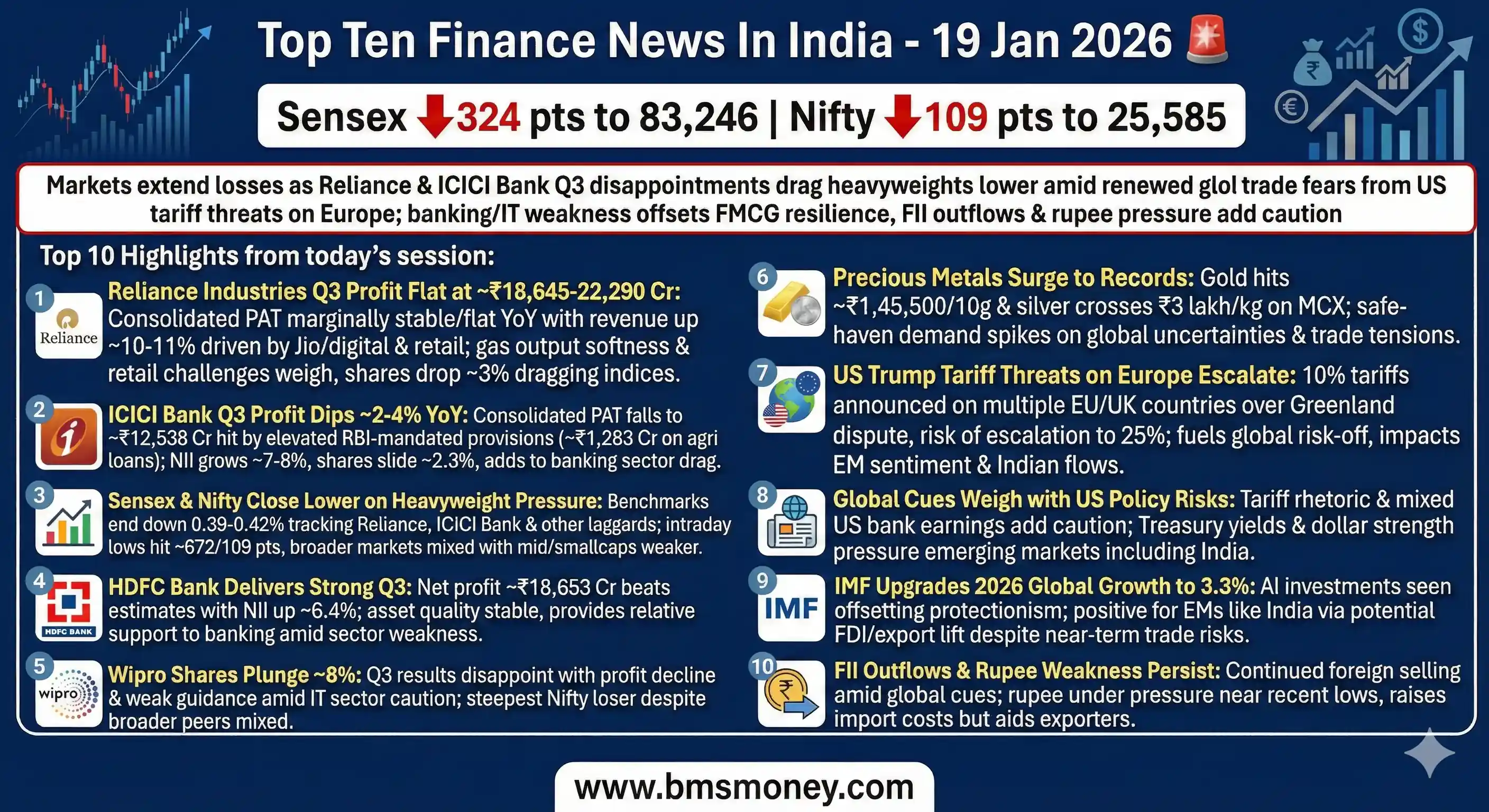
Markets closed lower on January 19, 2026, amid heavy profit booking, weak Q3 earnings from heavyweights, and heightened global trade uncertainty.
Key Themes & Picks
-
Broad-based selling drags indices lower as heavyweight earnings disappoint.
-
Banking, IT, and energy sectors lead the decline.
-
Safe-haven demand pushes precious metals to record highs.
-
Escalating US trade policy risks weigh heavily on global sentiment.
-
FMCG shows defensive resilience amid the sectoral downturn.
US President Trump Threatens 10% Tariffs on Eight European Countries Over Greenland Dispute
US President Donald Trump announced plans to impose 10% tariffs on goods from Denmark, Norway, Sweden, France, Germany, the Netherlands, Finland, and the United Kingdom starting February 1, 2026, escalating to 25% by June 1 unless a deal is reached for US control over Greenland. This move intensified global trade tensions, prompting European leaders to consider retaliatory measures worth up to $108 billion. Markets reacted with caution, as investors assessed potential supply chain disruptions and inflationary pressures. The threat contributed to a risk-off sentiment worldwide, including in emerging markets like India. Gold and silver prices received a strong safe-haven bid as a result. European stocks underperformed compared to other regions. The dollar eased against safe-haven currencies like the yen and Swiss franc. Analysts noted that markets have become somewhat desensitized to such rhetoric but remain vigilant about implementation risks. The policy could impact transatlantic trade volumes significantly. It highlighted ongoing geopolitical frictions under the current US administration. Indian exporters to the US and Europe might face indirect effects through altered global flows. The announcement underscored vulnerabilities in international relations affecting commodity and equity markets. Overall, it added to volatility expectations for the near term. Long-term risks to global growth were flagged by economists. The EU's potential countermeasures could broaden the economic fallout. This development reinforced the importance of monitoring US trade policy closely. It served as a reminder of how political decisions influence financial stability.
The Guardian, https://www.theguardian.com/business/nils-pratley-on-finance/2026/jan/19/markets-trump-us-eu-tariffs
Indian Stock Markets Close Lower as Reliance and ICICI Bank Weigh on Indices
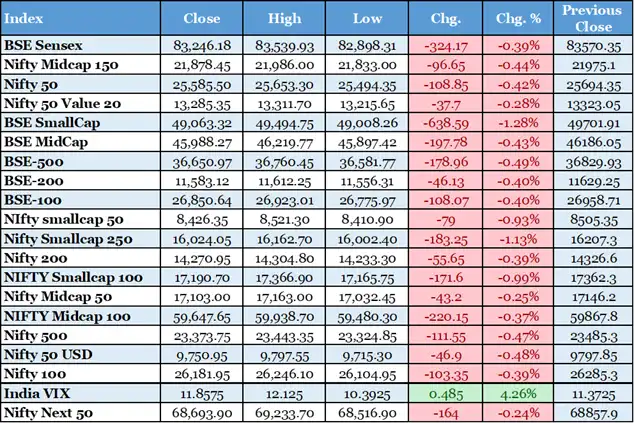
Benchmark indices Sensex and Nifty ended the trading session in the red, with Sensex falling 324.17 points or 0.39% to 83,246.18 and Nifty declining 108.85 points or 0.42% to 25,585.50. The downturn was primarily driven by losses in heavyweight stocks following their quarterly earnings releases. Broader markets also saw pressure, with Nifty Midcap 100 down 0.37% and Smallcap index slipping 0.99%. Selling was evident across most sectors, particularly energy, banking, and IT. FMCG emerged as a relative outperformer with modest gains. Intraday lows saw Sensex drop as much as 672 points and Nifty nearing 25,494. Foreign institutional outflows added to the cautious mood. Global tariff uncertainties from the US contributed to the negative sentiment. Domestic investors opted for profit booking ahead of key events. Realty, oil & gas, and media sectors witnessed sharper declines. Defensive plays in consumer goods provided some support. The session reflected a mix of earnings disappointment and external risks. Volumes remained moderate as participants assessed implications. Technical levels around 25,600 for Nifty proved resistant. Analysts anticipated continued consolidation in the near term. The close below key supports signaled short-term bearishness. Market breadth was negative with more losers than gainers. Overall, the day highlighted vulnerability to stock-specific news. It underscored the influence of large-cap performance on indices.
The Hindu BusinessLine, https://www.thehindubusinessline.com/markets/stock-market-live-updates-19-january-2026/article70521877.ece
Reliance Industries Reports Flat Q3 Profit, Shares Drop Sharply
Reliance Industries announced a consolidated net profit of Rs 18,645 crore for Q3 FY26, showing marginal growth compared to the previous year. Revenue from operations rose 11% YoY to Rs 2.69 lakh crore, supported by digital services and other segments. However, declines in gas production and retail weakness offset gains elsewhere. EBITDA remained stable amid cost pressures. The results failed to meet elevated market expectations. Shares of Reliance declined 3.04% on the BSE, dragging major indices lower. Investors reacted to the flat profit trajectory despite revenue uptick. Jio's subscriber additions and 5G rollout provided positives in telecom. Retail business faced competitive challenges. O2C segment showed resilience but was impacted by input costs. Capital expenditure stood at Rs 33,826 crore for the quarter. The company maintained guidance on future growth drivers. Analysts noted the mixed performance across verticals. The announcement contributed significantly to market weakness. It highlighted sector-specific headwinds in energy and retail. Long-term prospects remained tied to diversification efforts. The stock's movement reflected its heavy weighting in indices. Overall sentiment turned cautious post-results. The flat profit underscored margin pressures in key areas. It prompted reevaluation of valuation multiples. Investors awaited clarity on strategic initiatives.
ICICI Bank Q3 Profit Declines 4% YoY Due to Elevated Provisions
ICICI Bank reported a standalone net profit of Rs 11,318 crore for Q3 FY26, down 4% from the year-ago period. The decline was attributed to higher provisions, including those for agricultural loan reclassifications as directed by RBI. Net interest income grew 7.7% to Rs 21,932 crore, supported by loan expansion. Operating expenses rose 13.2% amid branch additions and investments. Asset quality showed improvement with lower NPA ratios. Consolidated profit stood at Rs 12,538 crore, reflecting a 2.68% dip. Fee income and other non-interest streams provided support. The board approved a two-year extension for the MD & CEO. Loan growth remained solid across retail and corporate segments. Deposits increased, aiding liquidity position. Treasury impacts added some pressure. The results came below analyst estimates. Shares fell 2.26% in response, contributing to banking sector drag. Provisions more than doubled in certain areas. Core operating profit grew despite challenges. The performance highlighted regulatory compliance costs. Analysts viewed the dip as temporary. Long-term growth in retail lending was emphasized. The extension signaled continuity in leadership. Overall, it reflected resilient fundamentals amid headwinds. The announcement weighed on financial stocks broadly.
The Economic Times, https://m.economictimes.com/markets/stocks/earnings/icici-bank-q3-results-pat-falls-4-yoy-to-rs-11318-crore-below-estimates/articleshow/126610286.cms
HDFC Bank Delivers Solid Q3 Performance with Profit Growth
HDFC Bank posted a net profit of Rs 18,653 crore for Q3 FY26, surpassing market expectations. Net interest income increased 6.4% to Rs 32,615 crore on strong loan book expansion. Asset quality remained stable with controlled provisions. The results provided positive momentum in the banking space. Shares showed relative resilience amid broader declines. Retail and corporate lending drove growth. Deposit mobilization efforts continued effectively. Operating metrics improved sequentially. The performance contrasted with peers facing pressures. It boosted confidence in private sector lenders. Analysts highlighted steady execution. Capital adequacy ratios stayed comfortable. Fee-based income contributed meaningfully. The quarter reflected benefits from merger synergies. Digital initiatives supported customer acquisition. Overall, it offered a counterbalance to sector weakness. The strong showing aided FMCG-linked sentiment indirectly. Investors viewed it as a sign of banking sector resilience. Guidance remained optimistic for future quarters. The results underscored HDFC Bank's market position. It helped limit downside in financial indices.
India Infoline, https://www.indiainfoline.com/news/markets/top-stocks-for-today-19th-january-2026
Wipro Shares Plunge 8% Following Weak Q3 Earnings and Guidance
Wipro reported disappointing Q3 results, missing estimates on revenue and profitability. Guidance for the subsequent period also fell short of expectations. Shares plunged 8.21%, becoming the top loser on the Nifty. The decline reflected broader IT sector caution amid global uncertainties. Client spending patterns remained subdued in key markets. Margin pressures persisted due to wage and investment costs. Deal wins provided some offset but were insufficient. The performance highlighted challenges in turnaround efforts. Analysts downgraded near-term outlook. It contributed to IT index weakness. Broader market sentiment amplified the move. Volumes surged on the sell-off. Technical supports were breached intraday. The drop weighed heavily on index performance. Sector peers faced similar pressures. Long-term digital transformation themes persisted. However, short-term headwinds dominated. The results prompted reevaluation of valuations. Investors adopted a wait-and-watch approach. Overall, it underscored earnings sensitivity in IT.
Angel One, https://www.angelone.in/news/stocks/top-gainers-and-losers-on-january-19-2026
Silver Futures on MCX Breach Rs 3 Lakh per Kg Mark
Silver futures for March delivery on MCX surged to a record high of Rs 3,01,315 per kg, up 4.71% intraday. The rally was driven by strong safe-haven demand amid global trade tensions. Investor buying intensified following US tariff announcements. Industrial demand provided underlying support. Global silver prices on COMEX also trended higher. The breach of Rs 3 lakh marked a historic milestone. It reflected heightened uncertainty in financial markets. Precious metals outperformed equities on the day. Inflation hedging motives added to momentum. Supply constraints in mining supported prices. The move influenced commodity-linked sentiment. Retail and ETF buying remained robust. Analysts anticipated continued volatility. It positively impacted commodity traders. Overall, it signaled risk aversion. The surge aligned with gold's upward trajectory. It highlighted metals' role in portfolios during uncertainty.
Gold Prices Hit Record High on MCX Amid Safe-Haven Buying
Gold futures on MCX climbed to Rs 1,45,500 per 10 grams, marking an all-time peak. The rise of approximately Rs 3,000 per 10 grams was fueled by global uncertainties. Trade tensions boosted demand for the yellow metal. Central bank purchases provided structural support. Geopolitical factors enhanced appeal. Domestic jewelry demand remained steady. Investment inflows into ETFs surged. The rally mirrored international benchmarks. Currency movements offered additional tailwinds. It benefited gold-related stocks and miners. Analysts viewed it as a hedge against volatility. Supply from recycling stayed limited. The record high underscored market dynamics. It positively influenced commodity indices. Overall sentiment favored precious metals. The move aligned with broader risk-off flows. It reinforced gold's status as a safe asset.
IMF Upgrades Global Growth Forecast for 2026 Amid AI Optimism
The International Monetary Fund raised its 2026 global growth projection to 3.3%, citing investments in artificial intelligence offsetting protectionist risks. The upgrade came despite ongoing trade frictions. Advanced economies were expected to contribute steadily. Emerging markets, including India, were seen benefiting from tech tailwinds. The forecast highlighted resilience in the face of uncertainties. It provided a positive counter to tariff concerns. Policy support in major economies was factored in. Inflation trends were projected to moderate. The revision boosted sentiment in growth-sensitive assets. It underscored the role of innovation in driving expansion. Indian markets could see indirect positives through FDI and exports. The outlook tempered some downside risks. Analysts incorporated it into broader views. Overall, it offered optimism amid challenges.
New York Times (adapted context), https://www.nytimes.com/2026/01/19/business/imf-world-economic-outlook-2026.html
German Investments in US Halve in Trump's First Year Back
German investments in the United States declined 45% during President Trump's first year in his current term, attributed to trade uncertainties and currency shifts. The drop reflected caution among European corporates. It signaled potential redirection of capital flows toward emerging markets. Dollar depreciation played a role in the trend. Protectionist policies deterred commitments. The data highlighted broader FDI implications. It could benefit regions like India with stable inflows. Analysts monitored shifts in global investment patterns. The decline aligned with tariff rhetoric. Long-term effects on transatlantic ties were discussed. It added to concerns over economic fragmentation. Emerging economies positioned themselves as alternatives. The statistic reinforced diversification themes. Overall, it underscored evolving cross-border dynamics.