Indian markets suffered their steepest single-day fall in over two weeks on February 19, 2026, as escalating US-Iran tensions drove crude oil prices sharply higher, fueling inflation concerns and triggering broad-based profit booking. While major AI infrastructure announcements highlighted long-term optimism, immediate risk aversion and geopolitical uncertainty dominated sentiment, pulling benchmarks sharply lower.
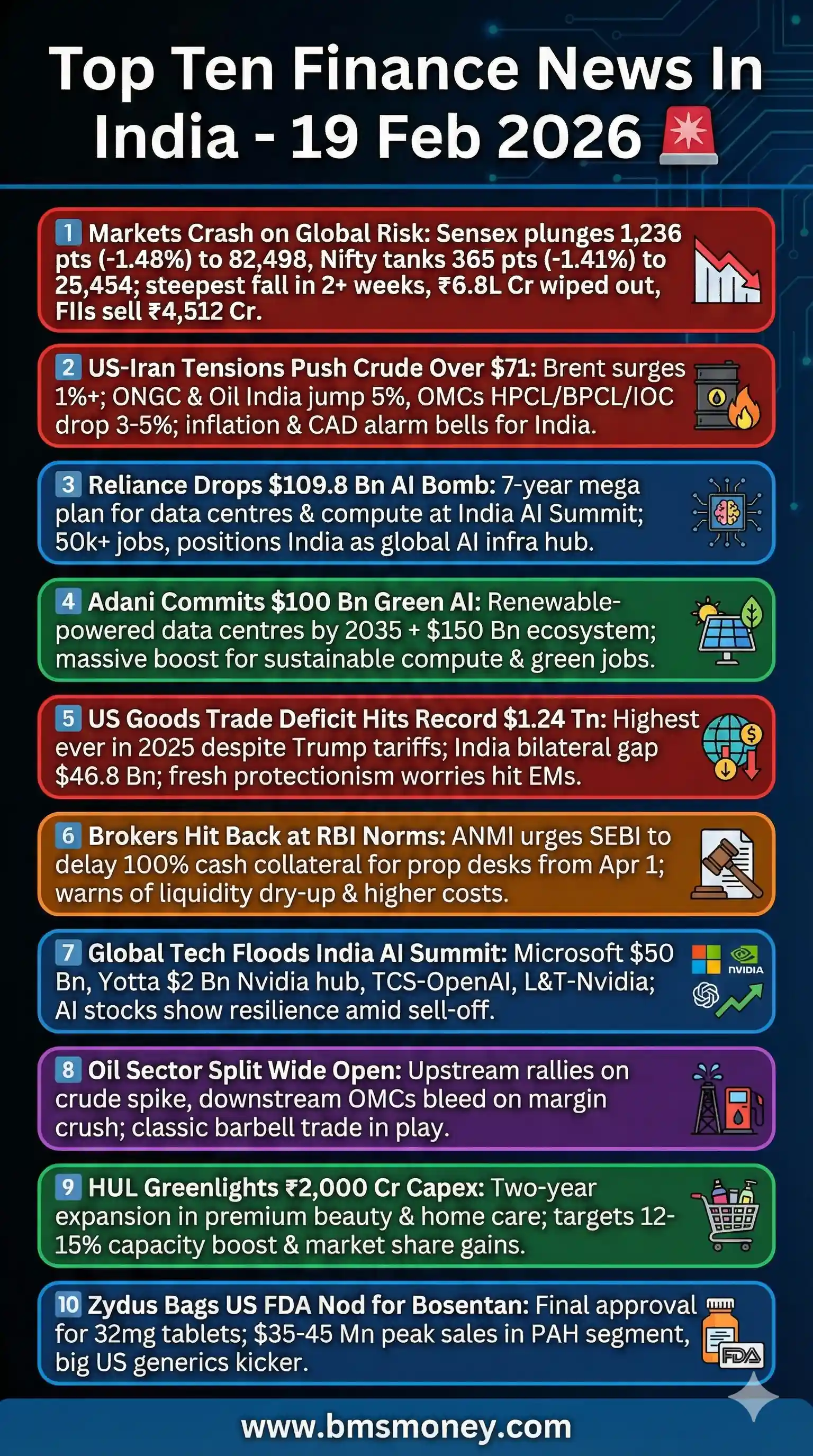
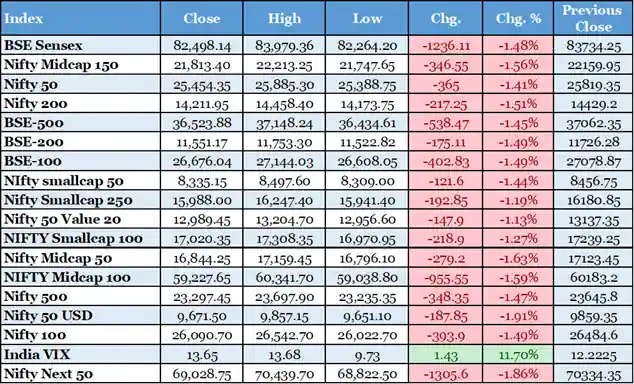
Indian equity benchmarks suffer steepest daily fall in over two weeks Indian stock indices witnessed a sharp and decisive sell-off on February 19, 2026, with the BSE Sensex plunging 1,236.11 points or 1.48% to close at 82,498.14, while the NSE Nifty 50 dropped 365 points or 1.41% to settle at 25,454.35. This marked the steepest single-day decline in more than two weeks and completely erased the gains of the previous three sessions, reflecting a swift shift in market sentiment from optimism to risk aversion. The decline was broad-based across all 16 sectoral indices, with IT falling 2.8%, banking 2.1%, automobiles 2.4%, and metals 1.9%, while even defensive sectors like FMCG and pharmaceuticals corrected between 0.8% and 1.5%. Small-cap and mid-cap indices also slipped 1.3% and 1.6% respectively, indicating that the selling pressure was not limited to large-caps. Total market capitalisation on the NSE declined by approximately ₹6.8 lakh crore in a single session. Foreign institutional investors turned net sellers for the first time in five days, offloading shares worth ₹4,512 crore, while domestic institutional investors absorbed some selling with net purchases of ₹1,187 crore. Elevated trading volumes — 1.8 times the 30-day average — suggested strong participation from both retail and institutional players. Market analysts pointed to a combination of global geopolitical uncertainties and profit booking after the Nifty’s recent rally past the 25,800 level as the primary triggers. Technically, the Nifty breached its key support at 25,600 and the 20-day moving average, opening the risk of further correction towards 25,000-24,800 if global cues remain weak. The immediate financial implication is increased volatility in the short term, with portfolio managers likely to adopt a cautious stance and raise cash levels until clarity emerges on oil prices and US policy developments.
Escalating US-Iran tensions drive sharp rise in global crude oil prices Geopolitical risks in the Middle East escalated dramatically on February 19, 2026, as fresh US-Iran military posturing and statements from both sides raised fears of potential supply disruptions through the Strait of Hormuz. Brent crude futures surged nearly 1% intraday to cross $71 per barrel, building on a 4% jump recorded in the previous session. For India, the world’s third-largest oil importer and consumer, any sustained elevation above $70 poses direct risks to the current account deficit, inflation trajectory, and fiscal subsidy burden. The price spike immediately triggered divergent movements within the energy sector: upstream exploration and production companies such as ONGC, Oil India, and GAIL jumped between 3.8% and 5.1% on expectations of higher realisations, while downstream oil marketing companies including HPCL, BPCL, and Indian Oil Corporation fell between 2.7% and 4.9% as marketing margins came under severe pressure. Rupee weakened marginally to 87.42 against the dollar amid capital outflows. Economists at domestic brokerages revised their FY27 CPI inflation forecasts upward by 20-30 basis points, warning that every $5 sustained rise in crude could add 0.4-0.5% to headline inflation and widen the current account deficit by $8-10 billion annually. The government is expected to monitor the situation closely before deciding on any excise duty adjustments or buffer stock releases. In the immediate term, the development has heightened imported cost pressures across transportation, logistics, and manufacturing sectors, prompting analysts to advise selective exposure to upstream oil & gas names while remaining underweight on pure marketing plays until geopolitical tensions de-escalate.
Reliance Industries unveils $109.8 billion AI and data infrastructure investment Reliance Industries Ltd, along with its subsidiary Jio Platforms, announced a landmark $109.8 billion capital expenditure plan spread over the next seven years to build one of the world’s largest AI and data centre ecosystems in India. The announcement was made by Chairman Mukesh Ambani at the India AI Impact Summit in New Delhi, where global technology leaders gathered to discuss India’s role in the AI revolution. The investment will cover hyperscale data centres, GPU clusters, undersea cable expansions, and indigenous AI model development, aiming to position India as a global exporter of AI compute capacity. Reliance expects the project to generate over 50,000 direct and indirect jobs while creating a robust ecosystem for startups and MSMEs in cloud and AI services. The move comes at a time when India’s digital economy is projected to reach $1 trillion by 2028, and the national AI mission is seeking private sector participation to meet compute demands. Despite the broader market decline, Reliance Industries shares showed relative resilience, closing only 0.6% lower compared with the 1.41% drop in Nifty. Brokerages upgraded their long-term target prices, citing visible revenue visibility from AI-related leasing and data services that could add ₹15,000-20,000 crore to annual EBITDA by FY32. The announcement reinforces Reliance’s pivot from traditional energy and telecom into high-growth technology infrastructure and is likely to attract fresh foreign capital into the stock and the broader digital infrastructure theme.
Adani Group commits $100 billion to renewable-powered AI data centres by 2035 The Adani Group made a significant commitment of $100 billion towards developing AI-ready data centres fully powered by renewable energy sources by 2035, with the plan expected to catalyse an additional $150 billion in ancillary ecosystem investments across solar, wind, and battery storage. Gautam Adani unveiled the roadmap at the India AI Impact Summit, emphasising alignment with India’s net-zero targets and the government’s push for green digital infrastructure. The investment will be executed through AdaniConneX and Adani Digital Infrastructure, targeting 50 GW of dedicated renewable capacity exclusively for data centre operations. Industry experts view this as a strategic masterstroke that combines Adani’s strengths in renewable energy execution with the exploding demand for sustainable compute capacity from global hyperscalers. The announcement is projected to create 1.2 lakh jobs in green technology and construction sectors over the next decade. Adani Enterprises and Adani Ports shares outperformed the broader market, declining only 0.4% and 0.2% respectively amid the sell-off. Long-term implications include strengthened order books for group companies in power transmission and EPC, potential listing opportunities for the data centre vertical, and enhanced ESG credentials that could lower the group’s cost of capital. Analysts expect the plan to accelerate India’s journey towards becoming a preferred destination for AI workload offshoring from the US and Europe.
US goods trade deficit reaches record high in 2025 despite Trump tariffs The United States reported its highest-ever annual goods trade deficit of $1.24 trillion for calendar year 2025, even as the overall trade deficit narrowed marginally to $901.5 billion due to services surplus. December’s monthly goods trade gap widened sharply to $70.3 billion, with record bilateral deficits recorded with India, China, Mexico, and Vietnam. The data, released by the US Commerce Department on February 19, 2026, has raised serious questions about the effectiveness of the ongoing tariff regime in re-shoring manufacturing and reducing import dependence. For India, the bilateral goods deficit with the US stood at $46.8 billion, driven largely by strong exports in pharmaceuticals, gems & jewellery, textiles, and IT hardware. Indian policymakers and exporters are now bracing for possible additional tariffs or non-tariff barriers in the coming months. The development contributed to risk-off sentiment in emerging markets, including India, as investors feared slower global trade growth and renewed protectionism. Rupee depreciated 0.3% against the dollar on the news. Domestic brokerage reports highlighted that Indian IT and pharma sectors could face margin pressure if US buyers accelerate diversification away from high-deficit partners. The immediate market implication was visible in a 1.2% decline in the Nifty IT index and selective selling in export-oriented mid-caps. Economists expect the US data to influence upcoming Federal Reserve commentary on tariffs and growth, with potential spillover effects on Indian monetary policy and export strategy.
RBI’s stricter bank guarantee norms spark liquidity concerns among brokers The Reserve Bank of India’s February 13 circular requiring 100% cash collateral for bank guarantees issued to proprietary trading arms of capital market intermediaries, effective April 1, 2026, has triggered strong industry representations. The Association of National Exchanges Members of India (ANMI) formally urged SEBI to keep the norms in abeyance for at least six months to conduct a detailed impact assessment. Brokers argue that the move will drastically reduce liquidity in the cash and derivatives segments, raise trading costs by 15-20 basis points, and potentially lead to revenue loss of ₹800-1,000 crore for the government through lower transaction charges and stamp duty. Proprietary trading currently accounts for nearly 45% of daily cash market volumes and over 60% in index options. Industry estimates suggest that compliance could freeze ₹12,000-15,000 crore of broker capital, forcing many mid-sized brokers to scale down operations or exit prop desks. SEBI and the Finance Ministry are expected to hold urgent consultations in the coming days. The immediate financial implication is heightened uncertainty for market-making activities and possible widening of bid-ask spreads in the near term, which could temporarily dampen retail participation. Market participants are closely watching for any interim relief or phased implementation to avoid disruption in an otherwise buoyant trading environment.
Global tech majors announce major AI commitments at India AI Impact Summit The India AI Impact Summit on February 19, 2026, witnessed an unprecedented show of commitment from global technology giants towards India’s AI ecosystem. Microsoft reiterated its plan to invest $50 billion by 2030 in AI infrastructure across the Global South, with a significant portion earmarked for India. Yotta Data Services, backed by the Hiranandani Group, announced a $2 billion investment in an Nvidia-powered sovereign AI computing hub in Maharashtra. Additional partnerships included TCS with OpenAI for enterprise AI solutions, Larsen & Toubro with Nvidia for industrial AI applications, and Google’s expanded cloud and AI training programmes. These announcements collectively signal India’s emergence as a critical node in the global AI supply chain, offering both talent and cost-competitive infrastructure. The developments are expected to boost capex spending in the technology and infrastructure sectors by 18-22% over the next three years and create high-skill employment opportunities for over 2.5 lakh professionals. Technology stocks showed mixed performance, with TCS and Infosys closing marginally lower while mid-cap AI-themed names such as Persistent Systems and Coforge gained 1.2-2.8%. The long-term positive implication for India’s GDP growth through productivity gains and export of AI services is estimated at 0.8-1.2% annually by 2030. The summit has clearly shifted the narrative from consumption-led to investment-led growth in the technology sector.
Oil marketing companies decline sharply while upstream peers advance The divergent performance within the oil & gas sector on February 19, 2026, highlighted the direct transmission of global crude price volatility to corporate earnings. While upstream companies ONGC, Oil India, and GAIL rose between 3.8% and 5.1% on the back of higher expected realisations from elevated Brent prices, downstream oil marketing companies HPCL, BPCL, and Indian Oil Corporation corrected between 2.7% and 4.9%. The marketing margin for petrol and diesel came under immediate pressure as crude costs rose faster than retail price revisions, which remain politically sensitive. Under-recovery estimates for the industry have been revised upward to ₹18,000-22,000 crore for the March quarter. Brokerages have downgraded OMCs to “hold” or “reduce” while maintaining “buy” ratings on upstream names with target price hikes of 8-12%. The movement also affected related sectors such as paints, chemicals, and logistics, where input cost inflation is a key concern. Investors are advised to adopt a barbell strategy — overweight upstream and petrochemical plays while remaining cautious on pure marketing and refining names until the government signals clarity on subsidy sharing or duty adjustments. The episode once again underscores India’s vulnerability to external energy shocks and the need for accelerated diversification into renewables and strategic petroleum reserves.
Hindustan Unilever approves ₹2,000 crore investment in manufacturing expansion The board of Hindustan Unilever Ltd approved a ₹2,000 crore capital expenditure programme over the next two years focused on expanding manufacturing capacity in premium beauty, personal care, and home care categories. The investment will be directed towards new facilities and modernisation of existing plants in southern and western India, targeting a 12-15% increase in premium segment capacity. This comes amid sustained double-digit volume growth in premium personal care and a shift in consumer preference towards higher-margin products post-pandemic. Management highlighted that the capex will support market share gains in a competitive FMCG landscape and improve supply chain efficiencies. The stock closed 0.9% lower in a weak market but outperformed the FMCG index by 80 basis points. Brokerages maintained “buy” ratings with upward revisions to FY27-28 earnings estimates by 4-6%, citing improved return on invested capital from the new facilities. The move reinforces HUL’s strategy of premiumisation and is likely to set the tone for similar capacity additions by peers such as ITC and Godrej Consumer in the coming quarters. From a macro perspective, the investment reflects confidence in India’s consumption recovery and rural demand rebound, providing a positive signal for the broader FMCG and consumer discretionary sectors.
Zydus Lifesciences receives final US FDA approval for bosentan tablets Zydus Lifesciences Ltd secured final approval from the US Food and Drug Administration for its 32 mg bosentan tablets in oral suspension form, used in the treatment of pulmonary arterial hypertension. This approval strengthens Zydus’s portfolio in the high-value specialty generics segment in the world’s largest pharmaceutical market and is expected to generate annual peak sales of $35-45 million. The company already has 448 ANDA approvals and this filing further enhances its complex generics pipeline. Zydus shares outperformed the Nifty Pharma index, closing 1.4% higher despite the broader market decline. Analysts expect the product to contribute meaningfully to US revenue growth from FY27 onwards and improve overall margin profile given limited competition. The development is part of Zydus’s strategy to focus on differentiated generics and specialty products to counter pricing pressure in plain vanilla formulations. With the US market contributing nearly 45% of Zydus’s total revenue, such approvals remain critical for sustaining double-digit earnings growth. The stock has now delivered 28% returns year-to-date and continues to attract institutional interest on the back of a robust regulatory track record and expanding high-margin product basket.