Indian markets closed lower on February 12, 2026, dragged by IT sector selling and global pressure from strong US jobs data delaying rate cut expectations. Positive domestic cues, including inflation easing back to the RBI's target band and major defense deal approvals, were overshadowed by broader risk-off sentiment.
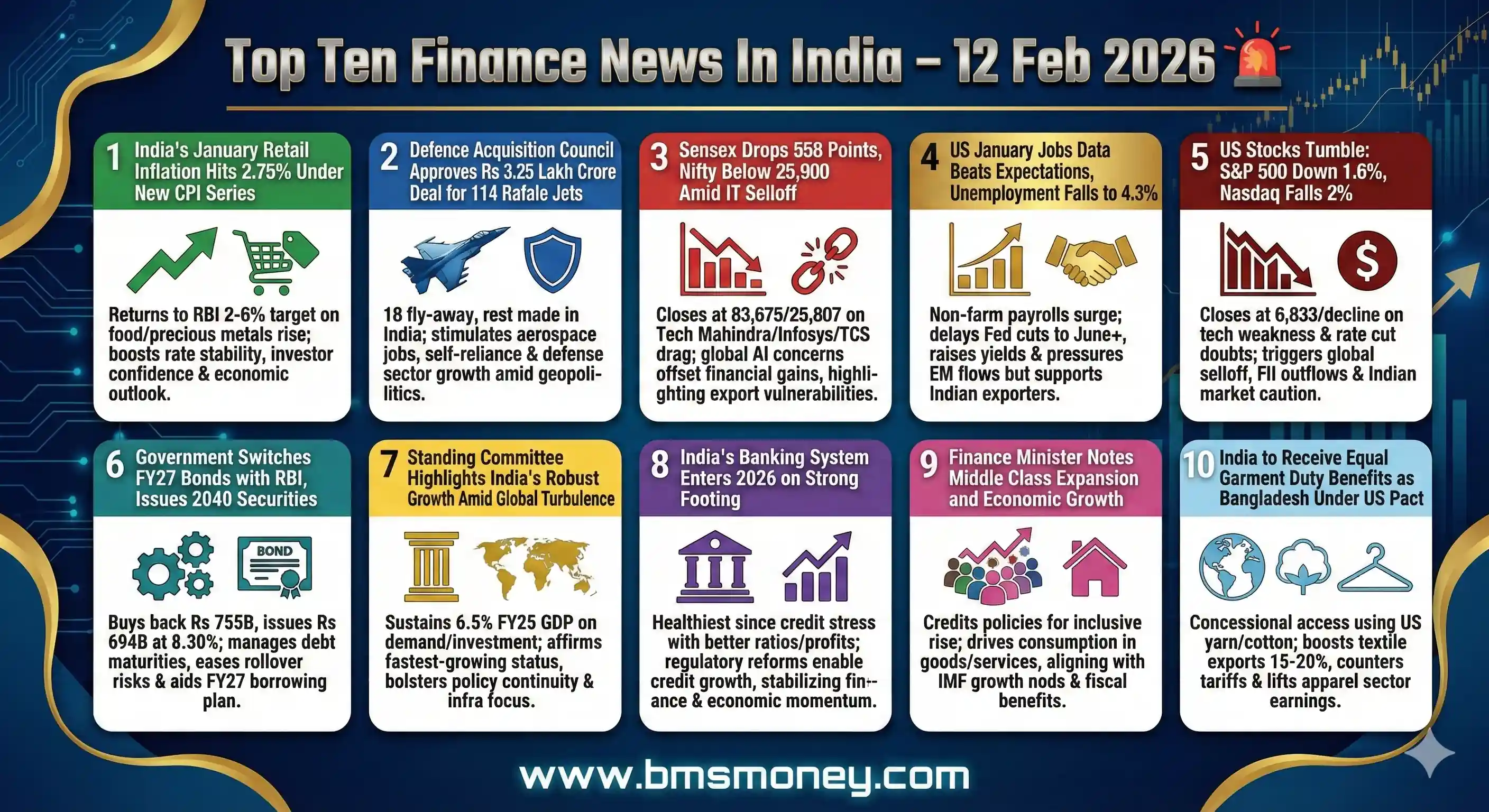
India's January Retail Inflation Hits 2.75% Under New CPI Series
India's consumer price inflation for January 2026 rose to 2.75% year-on-year, representing the inaugural data release under the revamped Consumer Price Index series that adopts 2024 as its base year. This uptick was primarily fueled by elevated prices in food items and precious metals, which exerted upward pressure on the headline figure. The revision in the CPI basket has adjusted weightings to better mirror contemporary consumption trends, notably reducing the emphasis on food from previous levels to align with shifting household spending patterns. Economists note that this recalibration provides a more accurate gauge of inflationary pressures in a modernizing economy. Importantly, the 2.75% rate brings inflation back within the Reserve Bank of India's mandated 2-6% target band after several months of deviation, which had prompted concerns over monetary policy tightening. This development is expected to foster greater stability in interest rates, as the RBI may hold off on hikes, thereby supporting borrowing costs for businesses and consumers. Investors reacted positively to this news, viewing it as a signal of controlled economic overheating amid robust growth. The immediate financial implication includes enhanced confidence in fixed-income markets, with government bond yields potentially easing slightly. Furthermore, sectors sensitive to inflation, such as real estate and consumer goods, could see improved valuations due to anticipated demand stability. Overall, this data release underscores India's progress in managing post-pandemic inflationary dynamics through proactive statistical updates. Policymakers are likely to leverage this for future budgeting, emphasizing fiscal discipline. In the broader context, it aligns with global trends of moderating inflation, aiding India's attractiveness to foreign investors.
Source & Link: Reuters, https://www.reuters.com/world/india/indias-january-retail-inflation-275-first-print-under-new-data-series-2026-02-12
Defence Acquisition Council Approves Rs 3.25 Lakh Crore Deal for 114 Rafale Jets
The Defence Acquisition Council, chaired by Defence Minister Rajnath Singh, has given the green light to a monumental procurement deal valued at Rs 3.25 lakh crore for 114 Rafale multi-role fighter jets from France's Dassault Aviation. This approval comes just ahead of French President Emmanuel Macron's scheduled state visit to India, highlighting the strategic timing to strengthen bilateral ties. Under the agreement, 18 jets will be delivered in ready-to-fly condition, while the remaining 96 will be manufactured domestically in partnership with Indian firms, promoting technology transfer and local expertise. This move is part of India's ambitious 'Make in India' initiative, aimed at reducing dependency on foreign imports and fostering self-reliance in defense production. The financial implications are multifaceted, including substantial capital outlays that could stimulate economic activity through job creation in the aerospace and manufacturing sectors. Analysts estimate that the deal could generate thousands of direct and indirect employment opportunities, boosting ancillary industries like electronics and materials. From a market perspective, shares of related companies, such as Hindustan Aeronautics Limited and Bharat Electronics, may experience upward momentum due to anticipated contracts. Geopolitically, this acquisition enhances India's air force capabilities amid rising tensions in the Indo-Pacific region, potentially deterring adversaries and securing trade routes. Budgetarily, the government has allocated funds from the defense capital budget, ensuring no immediate strain on fiscal deficits. Long-term, it could lead to cost savings through indigenous maintenance and upgrades. Investors in defense-themed funds are likely to view this positively, as it signals sustained government spending in the sector. Overall, this development reinforces India's position as a major global defense player.
Source & Link: The Financial Express, https://www.financialexpress.com/india-news/india-okays-rs-3-25-lakh-crore-deal-to-buy-114-rafale-fighter-jets/4140444/
Sensex Drops 558 Points, Nifty Below 25,900 Amid IT Selloff
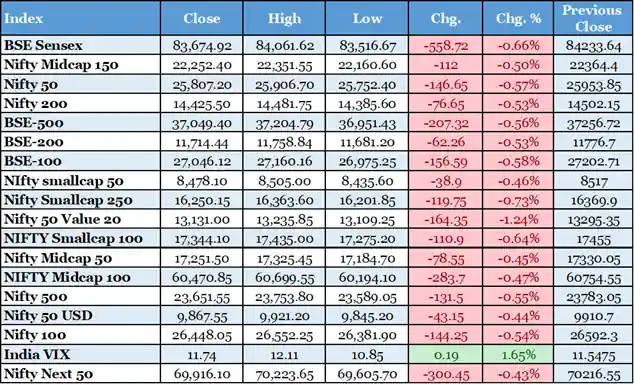
The benchmark BSE Sensex experienced a significant decline of 558.72 points, closing at 83,674.92, reflecting broad-based selling pressure across key sectors. Similarly, the NSE Nifty 50 index slipped by 146.65 points to settle below the 25,900 mark at 25,807.20, marking a volatile trading session. The primary driver behind this downturn was intense selling in information technology stocks, with major players like Tech Mahindra, Infosys, and Tata Consultancy Services plummeting by up to 6%. This IT sector weakness stemmed from global concerns over disruptions in artificial intelligence adoption and revised expectations for US interest rate cuts. Despite the overall bearish tone, certain financial stocks, including Bajaj Finance and HDFC Bank, provided some resilience with modest gains, cushioning the indices from steeper falls. Market analysts attribute the sentiment to negative cues from Wall Street, where tech-heavy indices also faltered. The immediate financial implication includes heightened volatility in equity markets, potentially leading to profit-taking by retail and institutional investors. Foreign portfolio investors may accelerate outflows, exacerbating rupee depreciation pressures. Sectorally, this highlights vulnerabilities in India's export-dependent IT industry, which contributes significantly to GDP and corporate earnings. Broader economic context involves ongoing global trade uncertainties, influencing investor risk appetite. Looking ahead, traders are monitoring upcoming corporate earnings for recovery signals. This event underscores the interconnectedness of Indian markets with international developments, prompting calls for diversified portfolios.
Source & Link: Times of India, https://timesofindia.indiatimes.com/business/india-business/stock-market-today-nifty50-bse-sensex-february-12-2026-dalal-street-indian-equities-global-markets-india-us-trade-deal-donald-trump/articleshow/128236056.cms
US January Jobs Data Beats Expectations, Unemployment Falls to 4.3%
The United States reported a stronger-than-anticipated addition to non-farm payrolls for January 2026, surpassing economist forecasts and indicating persistent labor market vigor. Unemployment rate unexpectedly decreased to 4.3% from the previous 4.4%, raising questions among experts about the accuracy and sustainability of such robust figures. This data release from the Bureau of Labor Statistics highlights ongoing economic resilience despite high interest rates. Sectors like healthcare, leisure, and professional services led the job gains, while manufacturing showed moderate growth. However, some analysts express skepticism, suggesting potential revisions in future reports due to seasonal adjustments. The immediate implication for global markets is a diminished probability of Federal Reserve rate cuts in the near term, possibly delaying them until June or beyond. Higher US Treasury yields could result, attracting capital away from emerging markets like India. For Indian investors, this means potential challenges for exporters facing a stronger dollar and competitive pressures. Domestically, it reinforces expectations of steady RBI policies, as imported inflation risks remain contained. Broader context includes the US economy's defiance of recession fears, supported by consumer spending. Financial markets reacted with equity selloffs, as rate-sensitive sectors adjusted. This development could influence commodity prices, including crude oil, impacting India's import bill.
Source & Link: Fortune, https://fortune.com/2026/02/12/stocks-wall-street-us-jobs-number-fed-rate-cuts
US Stocks Tumble: S&P 500 Down 1.6%, Nasdaq Falls 2%
Wall Street witnessed a sharp correction on February 12, 2026, with the S&P 500 index dropping 1.6% to close at 6,832.76 amid widespread profit booking. The Dow Jones Industrial Average fell 1.3% to 49,451.98, while the tech-focused Nasdaq Composite shed 2%, reflecting heightened concerns in growth stocks. Key contributors to the decline included weakness in Cisco Systems and other technology firms, as enthusiasm for artificial intelligence waned. Strong US jobs data earlier in the day fueled fears that the Federal Reserve might maintain elevated interest rates longer than anticipated. This global market downturn sent ripple effects to Asian and Indian bourses, contributing to the bearish close in Mumbai. Immediate financial implications involve increased volatility in international portfolios, with potential for foreign institutional investor selloffs in emerging markets. Indian IT companies, reliant on US clients, faced amplified pressure, exacerbating sector losses. Broader economic context points to a cooling of the post-pandemic bull run, with investors reassessing valuations. Commodity markets, including gold and oil, showed mixed responses as safe-haven demand rose. Analysts predict continued caution until clarity on Fed actions emerges. This event highlights the dominance of US economic indicators in shaping global sentiment. For India, it underscores the need for domestic policy buffers against external shocks.
Source & Link: Yahoo Finance, https://finance.yahoo.com/news/major-us-stock-indexes-fared-211958824.html
Government Switches FY27 Bonds with RBI, Issues 2040 Securities
The Indian government conducted a strategic bond switch operation with the Reserve Bank of India, repurchasing Rs 755 billion worth of securities maturing in fiscal year 2027. In exchange, it issued Rs 694 billion in new bonds carrying an 8.30% coupon rate and maturing in 2040, effectively extending debt obligations. This maneuver is designed to smooth out repayment peaks and manage liquidity in the banking system. It forms part of the broader fiscal strategy to handle a record Rs 17.2 trillion gross borrowing program for FY27. By elongating maturity profiles, the government aims to reduce rollover risks and interest rate vulnerabilities. Financial markets welcomed the move, as it signals proactive debt management amid steady economic expansion. Immediate implications include improved cash flow for banks holding these securities, potentially boosting lending activities. Sectors like infrastructure and housing could benefit from enhanced credit availability. In context, this aligns with RBI's efforts to maintain systemic stability post-global uncertainties. Analysts note that such switches help contain fiscal deficits within targeted limits. Long-term, it could lower overall borrowing costs if yields remain benign. This operation reinforces investor confidence in India's sovereign debt framework.
Source & Link: Reuters, https://www.reuters.com/sustainability/boards-policy-regulation/india-switches-fy27-maturity-bonds-with-central-bank-issues-2040-paper-2026-02-12
Standing Committee Highlights India's Robust Growth Amid Global Turbulence
The Parliamentary Standing Committee on Finance presented its report to the Lok Sabha, emphasizing India's achievement of a 6.5% GDP growth rate in FY25 despite pervasive global geopolitical challenges. This performance positions India as the world's fastest-growing major economy, as corroborated by International Monetary Fund projections. Key drivers include resilient domestic demand, increased capital investments, and effective policy interventions. The committee praised the role of infrastructure development in sustaining momentum across sectors. In the face of international headwinds like trade wars and energy volatility, India's internal strengths have provided a buffer. Financial implications involve bolstered market sentiment, encouraging equity inflows and corporate expansions. Regulatory bodies such as RBI and SEBI are seen as pivotal in maintaining this trajectory through prudent oversight. Contextually, this report arrives amid discussions on budget allocations for FY27. It highlights opportunities in manufacturing and services for job creation. Investors may interpret this as a cue for long-term bets on Indian assets. Overall, it affirms policy continuity and economic resilience. This could influence upcoming monetary decisions favorably.
Source & Link: DD News, https://www.newsonair.gov.in/amid-turbulent-global-economy-india-sustains-robust-growth-standing-committee-on-finance-to-ls
India's Banking System Enters 2026 on Strong Footing
India's banking sector has entered 2026 in its most robust state since the last major credit stress period, according to industry assessments. Improvements stem from enhanced capital adequacy ratios, rising profitability, and comprehensive balance sheet cleanups. Regulatory reforms by the RBI have played a crucial role in fortifying resilience against shocks. Key metrics show non-performing assets at multi-year lows, enabling banks to focus on growth lending. This health is attributed to post-COVID recovery measures and digital transformations. Financial implications include accelerated credit expansion to support economic activities in areas like SMEs and infrastructure. Positive credit ratings from agencies reflect readiness to capitalize on macroeconomic tailwinds. In context, this stability aids in managing inflationary pressures and fiscal needs. Sectors such as finance and real estate stand to gain from easier funding. Analysts predict sustained earnings growth for listed banks. This development enhances overall investor trust in the financial ecosystem. It positions India favorably in global banking comparisons.
Source & Link: Eurasia Review, https://www.eurasiareview.com/12022026-indias-banking-system-enters-2026-on-its-strongest-footing-yet-analysis
Finance Minister Notes Middle Class Expansion and Economic Growth
In a parliamentary address, Finance Minister Nirmala Sitharaman highlighted the concurrent expansion of India's middle class alongside strong economic growth over recent years. She credited targeted policy measures, including tax reforms and social welfare schemes, for this inclusive progress. Data indicates rising disposable incomes and consumption patterns among this demographic. This growth is intertwined with broader GDP advancements, as per IMF endorsements. Financial implications encompass boosted demand in consumer durables, education, and healthcare sectors. It supports corporate revenues and stock market valuations in related industries. Contextually, this narrative aligns with recent budgets emphasizing empowerment and infrastructure. The minister's remarks aim to counter criticisms on inequality. Investors may see opportunities in middle-class focused investments like mutual funds. This could influence future fiscal policies toward sustained inclusion. Overall, it reinforces optimism in India's demographic dividend. It aids in attracting foreign direct investment.
Source & Link: The Hindu, https://www.thehindu.com/news/national/middle-class-expanded-economy-grew-finance-minister/article70625205.ece
India to Receive Equal Garment Duty Benefits as Bangladesh Under US Pact
Commerce Minister Piyush Goyal announced that India will now enjoy concessional duty access to the US market for garments made from American yarn and cotton, on par with benefits extended to Bangladesh. This stems from the recent bilateral trade agreement aimed at deepening economic ties. The move is expected to enhance competitiveness for Indian textile exporters amid global supply chain shifts. Financial implications include potential revenue boosts for apparel manufacturers, with estimates of increased exports by 15-20%. It counters threats from proposed US tariff hikes on other nations. In context, this levels the playing field in a key sector employing millions. Corporate earnings in textiles could see upliftment, benefiting listed firms like Raymond and Arvind. Policymakers view this as a win for 'Make in India' in value-added products. Broader trade dynamics involve navigating US-India relations post-elections. Investors are monitoring implementation details for supply chain impacts. This development strengthens India's position in global apparel trade. It promotes sustainable sourcing practices.
Source & Link: The Hindu, https://www.thehindu.com/news/national/india-to-receive-same-garment-benefits-as-bangladesh-under-us-trade-pact-goyal/article70623535.ece